
Android Studio on AMD Hackintosh
- Thread starter wesbaldur
- Start date
You are using an out of date browser. It may not display this or other websites correctly.
You should upgrade or use an alternative browser.
You should upgrade or use an alternative browser.

Should work as long as you follow the instructions below.
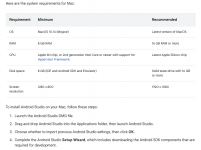 Minimum Requirements and installation process for Android Studio on Mac.

 developer.android.com
If you run in to issues, you could try adding AMDFriend.kext to your OC setup and see if that helps.

 github.com
Minimum Requirements and installation process for Android Studio on Mac.
Install Android Studio | Android Developers
Set up and install Android Studio on Windows, macOS, or Linux.
developer.android.com
If you run in to issues, you could try adding AMDFriend.kext to your OC setup and see if that helps.
GitHub - NyaomiDEV/AMDFriend: Experimental project that hex patches MKL-using libraries to work on AMD Hackintoshes.
Experimental project that hex patches MKL-using libraries to work on AMD Hackintoshes. - NyaomiDEV/AMDFriend
github.com
Necroing this thread because it was a top result on an internet search.
Android Studio itself works fine on an AMD running Sequoia, but the standard emulated deployment environment for app development will not start (i.e. the virtual Android phone device that allows you to test your app). The Android Studio UI error is not very enlightening, but the root cause is QEMU attempting to use the nonexistent-on-AMD-OSX HVF (Hypervisor Framework) problem — the same reason we cannot run VirtualBox versions > 6.1.x .
One can disable the implicit "-accel hvf" with "-accel off" but then qemu will run with no acceleration (painfully slow, pixelated graphics, and several seconds to respond to a click on a Ryzen 9 5950x)
Android Studio itself works fine on an AMD running Sequoia, but the standard emulated deployment environment for app development will not start (i.e. the virtual Android phone device that allows you to test your app). The Android Studio UI error is not very enlightening, but the root cause is QEMU attempting to use the nonexistent-on-AMD-OSX HVF (Hypervisor Framework) problem — the same reason we cannot run VirtualBox versions > 6.1.x .
One can disable the implicit "-accel hvf" with "-accel off" but then qemu will run with no acceleration (painfully slow, pixelated graphics, and several seconds to respond to a click on a Ryzen 9 5950x)
Have you thought of running macOS as a bare metal installation on its own separate disk, Instead of as a VM? The graphics will work a lot better as a bare metal installation.
If you have removed the RX 5700 XT & RX 6900 XT GPUs, what are you using to drive the graphics in the VM?
If you have removed the RX 5700 XT & RX 6900 XT GPUs, what are you using to drive the graphics in the VM?
The bare metal in these cases is macOS running on an AMD processor.
The issue with VM guests on an AMD hackintosh host (i.e. a bare metal macOS host that has an AMD processor, wanting to run a guest VM like Android Studio device emulator, VirtualBox, Parallels, QEMU, etc) is that no one ever implemented/ported Apple's macOS Hypervisor Framework in a manner that will operate on AMD processors. That aspect of macOS is Intel-only and it is problematic for users that need a hackintosh that can run VM guests.
VirtualBox up to 6.1.x works on a bare metal AMD hackintosh host because it used its own virtualization framework (that still invoked hardware SVM functionality for acceleration). In VirtualBox 7+, they switched to use the macOS Hypervisor Framework, just like every other virtualization software does now, and as such that software does not run at all or runs with absolutely no hardware acceleration (as mentioned in my previous post).
Ergo, this thread implicitly touches on the same issue as this other thread, and these older versions of VirtualBox require increasingly severe interventions to run on later versions of macOS. I'll be on Sonoma for the foreseeable future for this reason.
Back on topic, I got the Android Studio emulator to run (extremely slowly) by disabling hw acceleration via a command line switch and launching the qemu virtual device from the terminal. Android Studio then finds the socket for the device and the IDE integration will Just Work at that point (such as it is), but as far as I can tell the device cannot be launched from within the Android Studio GUI because the necessary disabling switch can't be set that way.
tl;dr: people who want a hackintosh that can run VMs should probably choose Intel hardware.
The issue with VM guests on an AMD hackintosh host (i.e. a bare metal macOS host that has an AMD processor, wanting to run a guest VM like Android Studio device emulator, VirtualBox, Parallels, QEMU, etc) is that no one ever implemented/ported Apple's macOS Hypervisor Framework in a manner that will operate on AMD processors. That aspect of macOS is Intel-only and it is problematic for users that need a hackintosh that can run VM guests.
VirtualBox up to 6.1.x works on a bare metal AMD hackintosh host because it used its own virtualization framework (that still invoked hardware SVM functionality for acceleration). In VirtualBox 7+, they switched to use the macOS Hypervisor Framework, just like every other virtualization software does now, and as such that software does not run at all or runs with absolutely no hardware acceleration (as mentioned in my previous post).
Ergo, this thread implicitly touches on the same issue as this other thread, and these older versions of VirtualBox require increasingly severe interventions to run on later versions of macOS. I'll be on Sonoma for the foreseeable future for this reason.
Back on topic, I got the Android Studio emulator to run (extremely slowly) by disabling hw acceleration via a command line switch and launching the qemu virtual device from the terminal. Android Studio then finds the socket for the device and the IDE integration will Just Work at that point (such as it is), but as far as I can tell the device cannot be launched from within the Android Studio GUI because the necessary disabling switch can't be set that way.
tl;dr: people who want a hackintosh that can run VMs should probably choose Intel hardware.
Last edited:
Try running the macOS VM following this guide instead of using VirtualBox.

*** First of all, don't make any changes to the vmware .vmx file. It is recommended that you create a new virtual machine from scratch so that it recreates this file by default and without any changes.
*** Use VMWare Workstation Pro version at the link provided in the tutorial. (If you install it, you will have to make a new Patch as described)
*** Enable AMD-V or INTEL VT (Virtualization Technology) in BIOS. (you should research how to do this on your machine)
1) First you need to download VMWare Workstation Pro:
- VM Workstation Pro 17.6.3: (NOW...
*** Use VMWare Workstation Pro version at the link provided in the tutorial. (If you install it, you will have to make a new Patch as described)
*** Enable AMD-V or INTEL VT (Virtualization Technology) in BIOS. (you should research how to do this on your machine)
1) First you need to download VMWare Workstation Pro:
- VM Workstation Pro 17.6.3: (NOW...
- tucano2000
- Replies: 766
- Forum: Virtual Machines

